


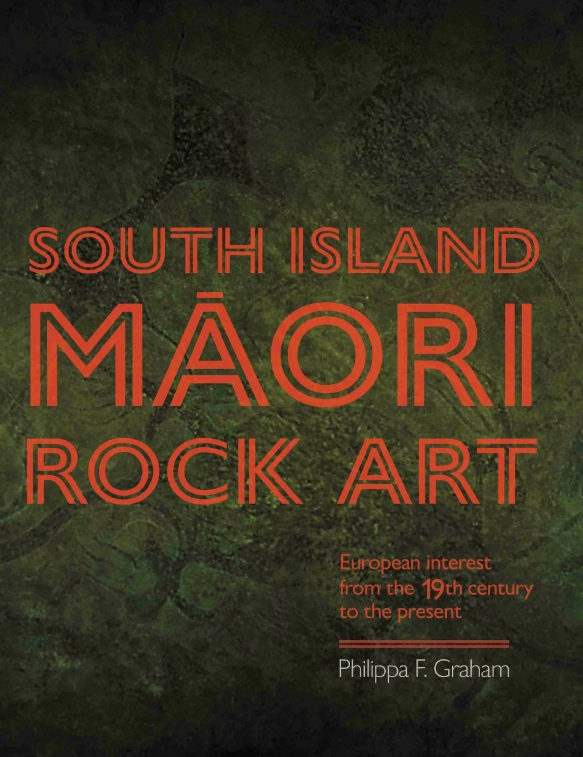
Philippa Graham is a Christchurch-born writer who has lived all her married life in South Canterbury, near Māori rock art sites. Her book, ‘South Island Māori Rock Art: European interest from the 19th century to the present’ is the culmination of many years of exploring and helping to protect these important and fascinating sites.
scientific curiosities by many early European explorers and, later, museum curators, including Julius von Haast, Alexander Hamilton, Robert Speight, W.H. Skinner and H.D. Skinner.
First of all, congratulations on the book. It’s a very good looking book!
PG: Yes, it’s quite surprising!
Surprising how?
It looks superb really; it looks like a bible. It’s even got a red ribbon in it!
How long have you been interested in this subject, Philippa?
Ever since I had children and we lived in the South Canterbury area. We lived in Cannington and I used to take the children around to some of the riverbeds where there was limestone. I would check the limestone for drawings, and they would go down the river in rubber rafts. I used to do that a lot. Farmers would let me on to the land to have a look and I could see that some drawings had been ruined by dust, or rubbing, or just neglect and that was when I started to think about the need for fencing and I approached John Daniels of the Historic Places Trust and he backed us to start a photographic and fencing programme in the 1980s.
I guess in those days people didn’t realise the significance of the drawings to some extent.
I think you’re right there. Certainly, at that time Māori were well and truly out of the picture and so gradually there’s been increasing interest with people recording smaller sites that were unknown until recently, and the farmers are becoming much more conservator minded.
When you say Māori were out of the picture, what do you mean by that? Because they weren’t allowed on their land?
Definitely. In the early Timaru Herald you see advertisements, for example, in the Hazelburn area where farmers are saying “on no account are any Māori with their dogs to go on the property.” So, they were very confined. Farmers would not have liked Māori going on to the land – when for comparison I did – because they would have felt threatened. The whole situation has changed now thank goodness.
How much has been lost because of that? the fact that Māori weren’t able to access their taonga?
I’m sure that a lot have been lost through that. I was able to walk among some of the sites with local Māori and they were able to interpret the drawings -like the double headed dogs and things like that. There’s a certain amount of loss in terms that knowledge and the interpretation of some of these drawings being passed down that has been lost.
This is fairly well known, but some of our major artists actually painted or traced over some of the rock drawings – did you find a lot of that?
Are you talking about European artists?
Yes, European artists.
Definitely. Theo Schoon is a classic example. What he did was to pick out motifs that appealed to him as a modern artist, and he went and produced a lot of decorated boards. The Dunedin Museum has some and the South Canterbury Museum has a few – but what he actually did was to highlight a lot of these motifs with black crayon or red crayon.
On the actual rock drawings themseves?
Oh yes. Some of them are very noticeable. Luckily, he ignored motifs that didn’t appeal to him.
It’s unthinkable now, isn’t it?
Definitely. The good thing nowadays is that with modern photography, you’ve got a lot of faint or invisible motifs that are showing up, so that’s a very exciting advance.
Did you have a lot to do with local Māori when you were putting this together?
Oh yes, that was crucial. To me, that was so important. I was able to trace a couple of ancestors to descendants which was quite exciting.
The subtitle of the book is ‘European interest from the 19th century to the Present’ – did you find that when you first became interested in the drawings, there wasn’t a lot of acknowledgement from other Europeans in the importance of these drawings?
Possibly. I took my mentor Joe Waka, he was a Kaumatua from Arowhenua, and he wanted to go down to the Hocken library. Having been trained as a librarian I was able to help him trace some of his ancestry back to some of the drawings. So, there was interest in earlier Europeans but at the time I started with the fencing programme, there wasn’t widespread knowledge or interest I suppose.
How long did this project take you -from when you first started to think there was a book in it until now?
Probably I started to realise there were enough European records showing up in the different institutions in the early 2000s. That was when I thought there ought to be a book published because it’s so interesting and also because it’s so important.
What was your most surprising discovery during this process?
It was when I went down to the Otago museum years ago with my children when they were smaller and one of the curators said to me, “have you any idea where these blocks of rock drawings around the perimeter of the gallery came from?” and they hadn’t a clue. I went to the Hocken library and found the Elmore tracings with numbered drawings and I suddenly realised that was the way to identify the rock drawing slab – because Elmore had chopped them up -and I was able to piece together where the rock drawings had originated from and where they ended up being distributed to. I was able to find out where the slabs had gone to.
Have many of these rock drawings gone offshore?
Well, Elmore managed to smuggle some out of the country and they landed up in Seattle. One of them was repatriated by David Smyth and I was able to find another little one of a shark which had been buried in the Kairingai Chase Aboriginal slabs that’s been repatriated since.
The motifs that you’re most drawn to – are there any particular drawings you really love?
I do love the doggy ones at Hanging Rock. They’ve now been fenced off, and the have been photographed beautifully by Brian High. There’s another great work along the river at Raincliff, up on the cliffs there, which is very attractive. It’s just the variety I like. I like some of the European contact drawings done in charcoal of men on horseback and sailing ships.
How many works have you catalogued?
I haven’t catalogued many at all. I’d say what I’ve done is provide feedback and fencing.
So, the book is more of a comprehensive survey.
The book is factual history. I don’t interpret the motifs at all. I’ve included material of books that have been written, exhibitions, and displays -that sort of thing.
How many rock art sites would you estimate there are in the South Island?
Oh golly. I reckon there would be at least 400 – and of course there are some still to be discovered.
What are you hoping comes out of this book? Is it mainly awareness? There still seems to be a lack of awareness among many people that these drawings even exist.
I think so. It’s a very interesting story. I think there’s a need for people to realise what we have here and how unique it is. The Aboriginal drawings, for example, have a lot more awareness because they had such a huge array of minerals that they could use for colour. Here, Māori were only able to use red ochre, which they carried around with them, and charcoal, and limestone. The other thing I would like to raise awareness of is the fact that there is an assumption that South Island Māori didn’t have the carving and the timber that the North Island Māori had – and the fact that there are all these drawings tends to go unrecognised.
I didn’t realise that. This is predominently in the South Island?
Yes. There is some rock art in the North Island, but not a lot. The rock art is very much concentrated here in the South Island – North Otago, Otago, South Canterbury. There is a site in Southland, but the people there didn’t want that publicised because you get vandalism. I’d like to see much more recognition of this. I’d also like there to be more information on how to approach the drawings.
Do you know how many sites have been destroyed?
I know that Theo Schoon was mortified on the damage done to a drawing of an extinct eagle down in North Otago. It was appalling. You’ve only got to look at the Hanging Rock vandalism, there’s now just a faint pink figure, and there used to be a really wonderful frieze of drawings that were recorded at the time of Haast.
That’s heartbreaking.
It is. Ironically, we still have Elmore’s tracings and some photographs from Hamilton. But it is heartbreaking.
If there’s anything you’d like to come out of the book, what would that be?
I think I’d like people to be more aware of the drawings, and I’d like there to be more recording of these sites.
South Island Māori Rock Art by Phillipa F. Graham is available now in all good bookshops.