


 Go to Auckland University Press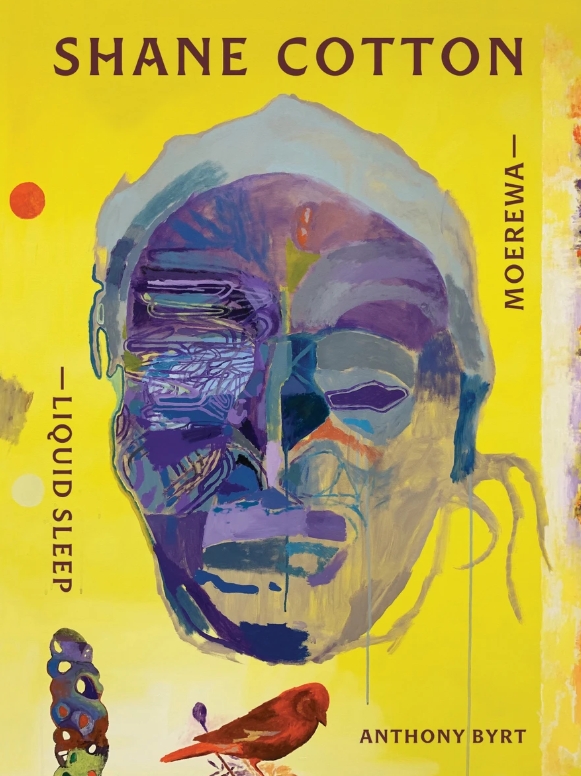
A new book exploring the work of one of Aotearoa’s most important living artists – Shane Cotton (Ngāpuhi, Ngāti Rangi, Ngāti Hine, Te Uri Taniwha) – is due to be released next month.
Moerewa | Liquid Sleep by leading art writer Anthony Byrt takes the reader on a journey to unravel the relationships, landscapes and histories that underpin Cotton’s work.
We spoke to Anthony about the book and his own discoveries within it.
Firstly, I have to say, the book is beautiful to look at!
I have to give Philip Kelly a huge amount of credit for the design of the thing. Both Shane and I felt very much that Phil was a collaborator. He was very much involved in conceptualising it and making it as beautiful as it is.
Shane Cotton was born in the North Island, but he studied here at Ilam, is that right?
His start as a painter was in Christchurch. He did his studies in Christchurch and really early on established a reputation for himself as an up-and-coming painter. That was a generation at Ilam which has subsequently become very special – Séraphine Pick, Peter Robinson and Tony De Lautour, and a whole lot of people who are really household names in New Zealand art happened to be there at the same time, and Shane was one of them.
As an aside, what do you think it is that produces these generations every so often?
I think with that particular generation – there was Ilam and there was Elam and they both had pretty heavy selection criteria. They weren’t big schools at that time. So, I think what happened is that you got this concentration of talent in the one place, in a small programme that was very focused on development. But sometimes there are different moments where you just get a beautiful confluence of a bunch of people coming together and starting to do amazing shit. That’s kind of what happened in the late 80s early 90s at Ilam for sure.
When did you first become aware of Shane and his work?
Probably when I was at university. Certainly, by the time I was at university doing art history in the late 90s, Shane was becoming a pretty prominent figure in New Zealand art. When he had a touring exhibition called ‘The Hanging Sky’ and it went to Brisbane, I wrote a Listener profile about Shane at that point and that was the start of the working relationship.
That working relationship is obviously very close, because it comes through in the book as a real collaboration – it’s quite a remarkable piece of art in itself.
Shane is particular about who he works with, and I think as we were developing this project and thinking about what it could be – he was very interested in the fact that I had these northern connections and that might open up a particular quality of dialogue. He wasn’t interested in just doing a standard art history text, it was about us both exploring a shared journey in this book.
Your own connections to the North were a revelation for him, but were they also a revelation for you?
The opportunity here was to look at the book as being with one person, one story, and one place for the duration of the book and so we really just delved into how deep we could go, how weird we could get, and I wanted it to be revelatory, or a discovery for me to. There’s such an intensity of a dream quality to Shane’s work, but there’s a very intense way that it intersects with our history as a country and so I wanted the text to mirror that. It was a great privilege to have an artist who trusted me enough to do that alongside him.
How long did it take from start to finish?
I think the conversation about doing this book probably emerged in 2022, and then I had a residency at the University of Waikato in 2023, and that was an opportunity for me to really knuckle down with this project. The University of Waikato was a pretty amazing place to do a bunch of research that fitted into Shane’s book. The secondary piece to that, of course, was the design work with Phil, because that is a very important part of the storytelling and that was something that Shane and I and Phil were very focused on. So quite a complex set of relationships, but it worked!
I imagine its different to other books, because when you’re working with an artist, the visual component of that book is as important at the prose.
Totally. Shane is a guy who is very, very active and his work is changing all the time, so his thinking is changing all the time. So, the visual form of the book needed to feel fluid and alive in a way that the work is. Even the title hints at that – Liquid Sleep.
Where did the title come from?
It’s a bit of a clunky literal translation of Moerewa, which is obviously a very important place to Shane in Northland but also, as we explore in the text, an ancestor figure who has appeared in his work. The water and the light is a very important part of the North, and so we wanted that title to have a strange quality.
It’s interesting looking through his work, because it looks like there was a change in Shanes work around the 2023/2024 period where suddenly the colours he’s using become so different.
He moved back to the North in around 2019 and the thing that’s very obvious when you live in that part of the world the light and the colour is totally different from where he had been which was Palmerston North. If you think about those big skies in the ‘Hanging Sky’ work – you get these big, moody, spray-painted works, very grand and expansive – that really ties, I think, into the fact that he had been working there for twenty years. Then the move up North – you get this almost tropical, lush, growth. You get much brighter light and so I think his work becomes so vivid because of that move.
You look at ‘Super Radiance’ and it almost looks like a completely different style.
Yes. I think that’s one of the things that we wanted to explore in the book, because Shane throughout his career does ostensibly change styles quite freely. What hadn’t really been done at length was an attempt to look at the linking threads, what are the constants in his work – and that was a really interesting challenge for me. Ultimately that’s where those histories of the North and the stories became the important thread that ran through it. the major thread that I think runs through Shane’s work is that everything is really about the strange beauty that is released in the collision between these two cultures. All the weirdness in his work, to me, is a tribute to the strange beauty of that.
Sense of place is a very interesting thread through artists work – has there been an appreciation for Shane’s work in Christchurch?
It’s interesting because there has always been a strong collector base and a strong museum base in Christchurch even though he’s never had a studio in Christchurch. I think he obviously tapped into a New Zealand history that people find resonant and can identify with.
We’ve been doing some stories on the rock art here in the South Island and the interesting thing to me was how specific that art is to the South Island – whereas the North Island is very strong on carving – the difference in artforms and I guess by extension painting styles – has a resonance even with that.
Theo Schoon and Gordon Walters explored that and then they in turn, become part of Shane’s visual whakapapa as well, there are obvious references in some of the work. You mentioned carving and that’s one of the great fascinations of the far north where the missionaries saw all these carvings as borderline satanic and it was all cleaned out of the meeting houses. So, houses in the North tend to be very sparse and when Shane was growing up, visiting marae or churches, it was this weird Christian imagery that was coming though, this was obviously a huge factor in Shane’s work throughout – that moment where te Reo becomes written and also a platform to explore spirituality. the sheer strangeness of that fusion and transformation is something he’s always been fascinated by, I think. The way that language operates in his work is comparable to McCahon, I think, in its importance.
You talk about violence in the work and I imagine that some of that is the sheer violence that was done with the missionaries removing carvings.
Yeah, totally. It’s this very challenging thing, that Shane and I talked about a lot, this productive force that violence has throughout New Zealand’s history and this is why a figure like Hongi Hika, is so complex and significant in the work. A lot of people have struggled with Shane’s work – particularly the heads – because of what they reference, but they exist, and they are part of our history. His ability to recognise where the extreme violence of an act then produces new forms, that’s what I think is driving the work.
Exploring what happens after a collision – whether natural or forced.
Yes, the creative force that shapes what Aotearoa is. I think, for me, I was asking questions of what does Shane represent to the culture, what is his work to the culture, and how has it made us understand the culture a little differently than some of the more simplistic conversations that happen sometimes in New Zealand about who we are and where we’ve come from. I think Shane is a quietly brave artist in that way.
As you referenced before – the collision of people as well. That’s a fairly significant in our history and in how you make sense of that.
Totally. I’m deeply fascinated by the relationship between Thomas Kendall and Hongi Hika. It was something that Shane and I talked about a lot. This is obviously the phase that is pre-treaty, pre- confiscation, and it is this moment in the North that is pure potential. where essentially these two guys collide. They sort of form this fused relationship in a very strange, but powerful way in terms of where New Zealand goes after that.
New Zealanders on a whole we don’t really have a good grasp of our own history let alone our art history – and this book is a real achievement bringing both of those things together
I’m trained in art history but I don’t call myself an art historian and I think that the nature of this book is me readily signalling that – It’s kind of me saying ‘I’m deeply invested in the culture of this place, I’m deeply invested in this place”, my personal story, I hope, as an opening to these histories in a new and different way alongside this incredible body of work that Shane’s made over a lengthy period of time.
Moerewa | Liquid Sleep is published by Auckland University Press and will be released on 8 October.