


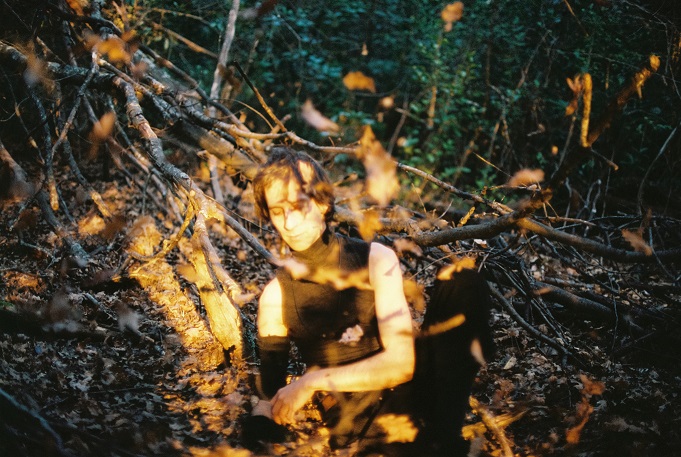
Martin Sagadin’s enigmatic debut album, Martin Iz Zgornje Bele, is sure to be one of the most talked about folk records in recent memory. Well known in New Zealand as a filmmaker and music video director with a poetic and surreal visual style, Sagadin’s music becomes an extension of their artistry, evoking vivid musical imagery executed with finesse and grace.
Sagadin was born in Kranj, Slovenia, but has lived in Aotearoa, New Zealand, for the past 19 years. In that time, they developed a reputation as the go-to music video director for artists like Aldous Harding, Tiny Ruins, Marlon Williams, The Bats and many others. With such worthy contemporaries, it’s all the more notable that Martin Iz Zgornje Bele sounds utterly different from any of those artists’ work.
The name of the album refers to the village in Slovenia that Martin grew up in. The choice to sing in their native Slovenian language was an intuitive pathway towards communicating rarefied and borderless emotions. The album paints a collection of delicate moments, sparsely arranged with fan organ, guitar, mandolin, recorders, cello and a small orchestra of instruments.
Martin will be performing at Flying Nun Records in Christchurch on Friday 5th December at 6pm – and again in January for the proper launch. We spoke to them ahead of their performances.
Hi Martin!
This is your debut album?
It sure is. It’s funny in some ways because the album has been ready for about two years but it’s only now being released. In the meantime, I’ve actually recorded two other albums.
Is that strange releasing something you’re so familiar with?
In some ways, yes. But I also like having something to revisit and breathe new life into it. While it’s familiar to me, of course to the world its new. There’s always an inevitable sort of anachronism when releasing music.
The album is all sung in Slovenian?
Yes, it’s all in the Slovenian language, but the treatment isn’t traditional, it’s my own thing. It has elements of inspiration from other cultures and folk traditions. I mostly sing in falsetto accompanied by a fan organ or mandolin or guitar – so the songs are made up of those three components. I also have lots of guests contributing, building on the songs.
Who do you have contributing?
The main contributor is my album producer, Brooke Singer from French for Rabbits. The album features Ben Lemi (Trinity Roots, Bret McKenzie) and Xanthe Rook (Recitals) on the clarinet, Liz Stokes (The Beths) on flugelhorn and Charlotte Forrester (Womb) on cello.
Gosh, you’ve really got some great names on this.
A lot of the people I’ve worked with through my music video work, so it’s been really fun collaborating in this new way.
Is there a theme that runs through the album?
The main theme would be nostalgia and homesickness. There’s also a couple of love songs. I wanted it to be a variety of styles – some are very short songs; some sound like classical and some sound like folk music.
Is there a tension for you between New Zealand and Slovenia, in terms of feeling pulled between two places?
There’s always a tension for all immigrants – this pull between identities -neither here nor there. I’m in an interesting situation right now also, because I moved here with my family and they’ve all since moved back to Europe. Writing these songs is a way of connecting back to my culture and language, as I don’t have many people to speak Slovenian with here.
And language is a really important part of culture, isn’t it?
Language is a living thing. It either lives or dies – there’s no in between. We often think about language as a tool but it’s much more than that. All of these songs start off as poetry, and I wrote them down and the melodies made their way to them. So, it really began as a writing project, but the music makes it much more accessible – if I write poetry in Slovenian, I’d have a hard time sharing that with my New Zealand friends. The world of music is more permissive in that way. We can enjoy music from languages we don’t know, and we can get to the emotional core of the songs without necessarily understanding the words.
Do you have a favourite song on the album?
The first single is my favourite STO VRAT – there was just something about this song that really clicked for me. This one features Liz Stokes on the flugelhorn and Charlotte Forrester on Cello. It felt like something that started off really small and then just came to life.
How are you so good at so many different things?
I’m very bad at many things! The art practices I do happen to be the things I’m good at. I guess I feel most at home in the creative world because I see it as full of opportunity and there are many things I love doing within it. I love making music videos and movies and now also music: these different ways of expression feed each other. I think it was Degas who said, ‘the muses don’t talk to each other, but they dance.’
You’re well known for your music video directing – what is the difference between that work and your music work?
The music videos are an interesting art form, they’re an auxiliary art form – they can’t exist on their own. With a music video it can’t exist without the music, and it also doesn’t exist in the tactile world but in a temporal (time based) world. But the music video will always partake of the tactile world. Still, the difference between making tactile and time-based art is vast. Music is also temporal, so it also unfolds in time, the song only happens if someone is listening to it.
What would you say is your style when it comes to directing music videos?
When I’m making music videos, I look for a visual gap in the song to fill – what can be added that will enrich the thing. Not just doubling up on what’s being sung, but finding the visual gap that can enhance and talk to the song.
Can you learn that?
You certainly get better at it if you keep doing it. When I started, I thought making a music video was like making a short film, but it’s quite different really. Some musicians see it as an extension of their persona, some see it as an ad to help record sales, and some musicians have a full vision for their work and you find yourself co-directing which is what happened with me and artists like Aldous Harding and Marlon Williams.
Is there a particular music video that just makes you go ‘wow?’
I really love what Sportsteam does. They’re a team of music video makers, who have just moved down here. I particularly like their collaborations with The Beths. I love their video for “Dying to Believe.”
Tell me about your upcoming performance at Flying Nun.
This Friday it’s a solo performance to celebrate the album release, starts at 6pm and its free. The proper show is on 10th of January at the Lyttelton Coffee Company, and for that one I’ll be joined by Xanthe Rook and Georgia Knight as my “bandmates” and Ben Woods will be opening for me.
And there are two more albums in the works?
Yes, they are quite different. One is for my father who passed away recently, and the other is an album of love songs.
Catch Martin Sagadin’s performance at Flying Nun Records, 143 Tuam Street on Friday 5th December at 6pm. All welcome for this free performance.