


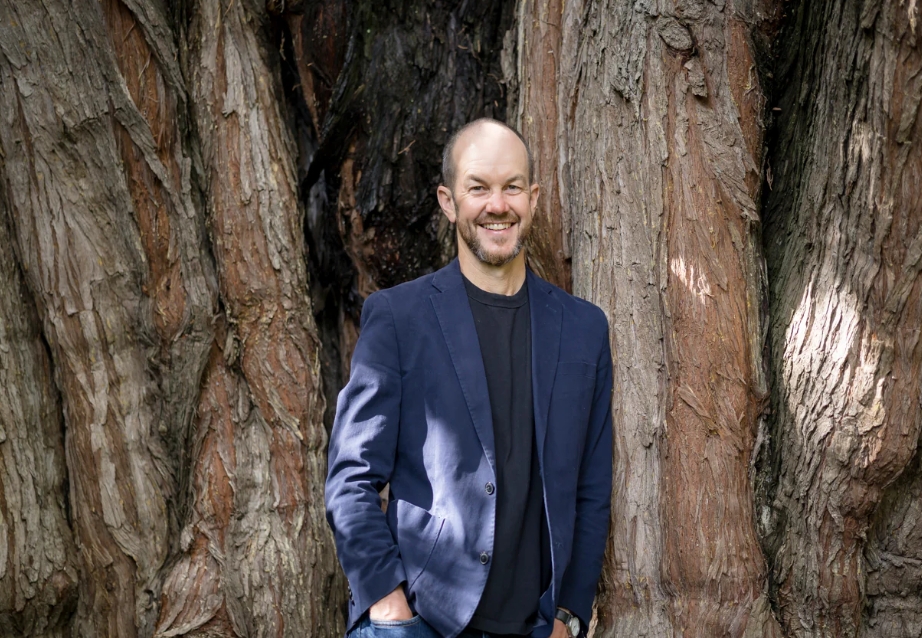
 Image: Janneth Gil
Lawrence Patchett is a Pākehā writer from Ōtautahi Christchurch. His previous books include I Got His Blood on Me: Frontier Tales, which won the NZSA Hubert Church Best First Book Award for Fiction.
His latest book, Have This Heart is a compulsively readable story collection about men who are trying to do better. Whether training a rescue dog, starting a bucket chain to put out a raging fire, raising a marquee beside a line of Ferraris, or reporting on a sensitive workplace accident, the men in Have This Heart are striving for more. For connection, for humour, for a way back into the world. The book will be available in June.
We spoke to Lawrence about the collection and his writing process.
This is your third book -how does it compare to your previous books?
In this one, I’m returning to short stories, which is the form I used in my first book. I had a bit of a block after my last book, so I decided the way to come back was to go back to the beginning and see if I could write short stories again. It took a while. A friend and I had a technique where we would meet up each week and we’d agree to write five minutes a week, which then became five minutes a day, and eventually, by setting ourselves low targets we both ended up writing publishable books.
It must be tricky to overcome writers block – how did you manage it?
There were a couple of things, really. One of the central questions in this book is to do with characters finding their way back into the world, and secondly there are big questions to do with exploring privilege. I was interested in using different points of view to explore how characters understand their own privilege and what they do with that information. In terms of my own block, I needed to rethink and reflect after publishing my previous book, the pandemic, and a period of relative isolation.
The idea of privilege is so interesting – there are so many examples of privilege that many of us don’t even realise we have.
That’s one of the things I really enjoyed exploring in this book – I have characters who are somewhat like me thinking about their own privilege and what to do with that. One of my favourite characters is in the story called ‘Lucky’. He’s an office bro and he’s slowly becoming aware of his privilege, but he keeps offending his workmates. He’s a type that some readers have said is instantly recognisable. This kind of exploring, through different characters, can be really fruitful in short fiction.
It sounds like a fascinating subject to explore.
It’s very much connected to the idea of characters finding their way back into the world. Some of them have made mistakes and they needing to come to terms with those mistakes and to own their actions, and then they have to figure out how to go back into the world. Lots of these characters are just starting to make those connections with other people – and not always successfully. But it does relate to the title. There’s an exchange going on in the stories, and often it’s an exchange of empathy.
How much do you draw from your own experience of life in your fictional work?
It varies. I enjoy the process of fiction writing; although I write realist stories, I also write some speculative stories. I haven’t tended to write too much in the semi-autobiographical area. In this book though, the emotional centre of the title story is connected to an experience I had. Sometimes I will give some of my own anxiety or uncertainty to a character and see what they do with it. It always goes somewhere I’m not expecting.
How important is imagination for a fiction writer?
There are lots of different kinds of fiction writers, I suppose. I’m certainly not someone who has stories bubbling out of them. When I go to the page and start writing, that process creates a character, and then the character creates a story. But imagination is helpful in a lot of ways – my first book was mostly historical fiction stories, and some were counter-factual, and so using the imagination there was pretty important, for making that leap across time into a quite different point of view.
This book has a common thread of men trying to do better – was this deliberate?
Yes, it pretty much captures what’s going on. At first I just wanted to get the process of fiction started again, but once I got underway I got more interested in exploring privilege, and particularly the kind of privilege I have access to. So it ended up being all male points of views – because that’s what I’m most familiar with. All the characters are trying to learn about themselves, in order to be better.
Did you learn anything about yourself when writing the book?
Over the period of seven years since my last book, I have learnt a lot about myself! Partly from writing this book, but then again, you always learn from the process of writing.
Do you find the actual process of writing difficult?
Each book has taken me about seven years to write, so there’s something in that! I need to be at the desk and working on it repeatedly, over successive weeks, before I can start writing well. Once the flow starts it’s enjoyable. but getting into that flow state takes a lot of work. That’s why it’s hard and you need to be dedicated.
Does publishing your work give you any anxiety?
There’s less of that this time for me, I think. I’ve enjoyed the process. There are 10 stories in this collection, but I wrote about 25 in total, so I was able to throw out the stories that weren’t working or that didn’t explore the book’s central questions. . I do get a little uncertain when editing my work: Is it a book yet, or just a pile of words? But with the support of other people who are involved, particularly the excellent editor and other staff at the publisher, I got more confident.
You also work as an editor – how much more ruthless are you with your work as compared to others?
As an editor, you’re very much working with a writer and at their side. You work as a team to get the book in the best shape it can be. In terms of my own work there’s a lot of re-editing and drafts. I’m pretty ruthless about chucking things out from my own work, whereas it’s different when you’re dealing with other people’s work.
You grew up in Canterbury – how has the environment shaped your writing?
I was raised on the Canterbury Plains. Certainly, the semi-rural outlook and the outdoors have influenced me. I grew up on a small farm and I’ve had a number of jobs working in the outdoors, so those experiences certainly had an influence on this book too. My publisher noticed that most of the characters are at work, some of them in the outdoors. That’s because I find work so fruitful in fiction: it pits your characters against difficulty, it forces them into interaction with other people, and it helps provide narrative shape to the story. I lived in the Wellington area for quite some time, and coming back after the pandemic has been really interesting. I’ve found it to be really fruitful for my creativity to be in Christchurch. It’s a super supportive community and there’s such an excited energy around the place, particularly in the community associated with Toi Auaha.
Lawrence Patchett’s ‘Have a Heart’ will be launched at Scorpio Books on 25 June.