


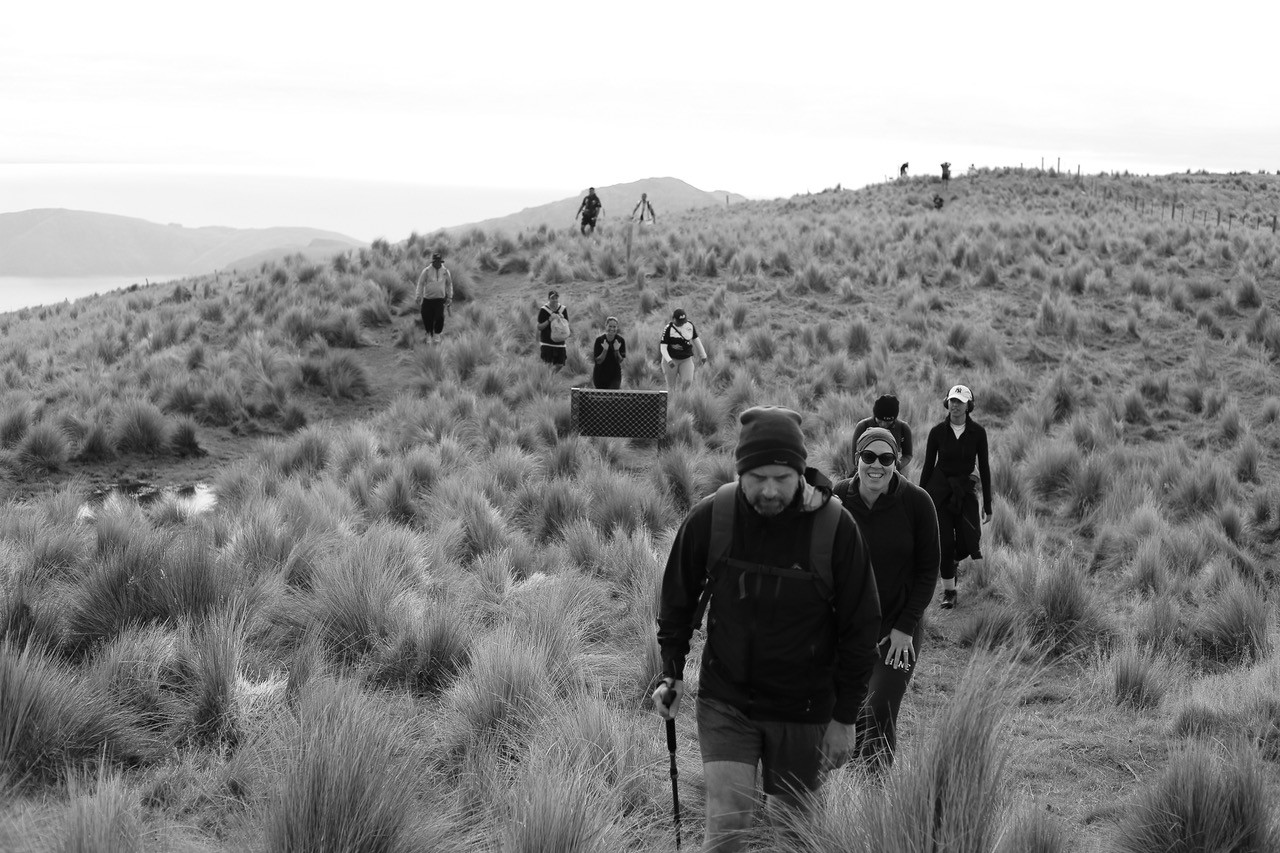
 Ross Calman leads whānau up Te Ahu Pātiki (Mt Herbert) in May, 2025 (Matt Calman)
After winning the celebrated Margaret Mahy Book of the Year prize for his latest work The Treaty of Waitangi (Oratia, 2025) Ross Calman has been busy connecting with youth, and celebrating the enduring mana of our founding document, and has just received the 2025 Prime Minister’s Award for Literary Achievement. Matt Calman catches up with his whanauka rongonui.
My cousin Ross (Kāi Tahu, Ngāti Raukawa-ki-te-tonga, Ngāti Toarangatira), has been researching and writing about The Treaty for more than two decades. At a ceremony at the Wharewaka Function Centre on Wellington’s waterfront on November 6, on the heels of his Treaty book prize, Ross was one of three writers honoured with a Prime Minister’s award. He was surrounded by whānau and supporters, fellow writers, and past winners. The recognition for his work in non-fiction came with a financial windfall of $60,000. He says of the award: “I was very surprised to get the call from Creative New Zealand and knowing that it comes with the financial [contribution] it means I can dedicate a good amount of my time next year to my creative writing. That’s such a gift for a writer. It’s very affirming after so many years writing these books to get this recognition at this stage of my career.”
Ross has a long history of writing for rangatahi through his school journal work with Reed Publishing. In 2019, he collaborated with Mark Derby, illustrator Toby Morris, and translator Piripi Walker, on bilingual graphic novel, also titled, The Treaty of Waitangi. He is an accredited translator of te reo Māori text, and in 2020, he released his seminal work He Pukapuka Tātaku i ngā Mahi a Te Rauparaha Nui nā Tamihana Te Rauparaha / A Record of the Life of the Great Te Rauparaha (Auckland University Press) – a translated and edited volume of the 1860s manuscript of Tamihana Te Rauparaha. In 2023, Ross was awarded an Honorary Doctor of Arts from Canterbury University for his mahi in Māori publishing and history, and in revitalising te reo Māori.
We have deep family history with The Treaty, in terms of our whanaunga who shaped events that led to its drafting and inception, and through our tupuna, Te Rauparaha, whose signature appears on two separate versions of the famous document. The recognition at The New Zealand Books Awards for Children and Young Adults came with a prize of $8,500 and led to Ross embarking on a book tour of Waikato schools in the heartland of the Kiingitanga.
M: What has been the reception to the book?
R: Kia ora Matt. The book Te Tiriti o Waitangi came out in January this year, but I guess in lots of ways it was quite a slow burning thing up until I won the Margaret Mahy prize in the middle of August. I’ve never won a big book prize like that before. And I think the number one thing that it’s meant is just to have the validation of my peers that this is an important book in this moment in our country’s history. It was quite an amazing feeling that sense of validation. You know, I’ve written about the Treaty … and been reflecting on [it] for more than 20 years. It’s been a big topic for our country throughout most of that time. There’s been a lot of controversy surrounding The Treaty. Winston Peters was trying to get the principles of The Treaty taken out of legislation about 20 years ago. And there’s obviously been a whole lot of major protests such as Ihumātao, the protest at Te Papa over the wording of The Treaty, and use of the English text over the Māori text. There’ve been major Treaty settlements, and of course [with] the current Government there’s been a contest over the ongoing relevance of The Treaty and its relevance of the Treaty and its place as our founding document, and in terms of its ongoing significance as well. With the book, I did do quite a lot of research in terms of bringing it up to date … but at the same time I didn’t want to go too deep into current debates about The Treaty because I didn’t want to give them too much airtime. I wanted the book to provide the basis for especially young readers to make up their own minds about The Treaty. I didn’t want to talk about … the current debates the current Government are trying to raise, that have really wrought division. In my mind within a couple of years those will be passed, and we’ll be talking about new things because the Government will be turfed out [laughs]. That’s how I’m looking at it. Since winning that prize it was amazing to get all the attention to that kaupapa at that time. It was only a couple of weeks later I went on the schools’ tour.
M: Who organised the schools tour and what did it entail?
R: It was organised through the Storylines Trust, a charitable organisation to bring writers and illustrators to schools. I think they do target schools that are the less well-off schools. When I heard about the concept of it, I must say I was initially quite freaked out by it, because it seemed like a punishing schedule. It involved three school visits a day for five days in a row. It was a mix of primary, secondary schools, and area schools. It depends on what the writer or illustrator does. Because my books are targeted at an older age group – roughly the age of 10 plus – it was an opportunity to connect with the audience of my books. It was in the Waikato. It was the first week of September. It was me and four other writers and illustrators [including] Reading Ambassador Kate De Goldi; children’s writer and illustrator Laura Shallcrass, and Whangārei-based Illustrator Kristin Kelly. We’d all head out to our different schools. The kids I was talking to were probably between 9 and 14. There was a mix of rural and urban. Some schools had quite a high Māori roll and others a higher Pākehā role from the more rural areas. I covered my own journey as a writer and my experience as a child reading and writing. And I read a couple of poems I wrote on the flight from Christchurch to Hamilton. Because now that I’m writing poetry, I thought that would be a nice way to introduce myself. I tried to incorporate humour and make things interactive. I found with all the sessions I found the children really engaged. They asked great questions. I just enjoyed the experience way more than I thought I would. I thought I’d be a bit more out of my comfort zone. I enjoyed all the little interactions with teachers and enjoyed visiting different parts of the Waikato – seeing the photos of previous [Māori] kings and queen on the wall and riffing off some of that history. When I would arrive at some places, I’d be sung a waiata and given a mihi, and just listening to [those] words and just talking about some aspects of history to do with the Kiingitanga and the New Zealand Wars, and the Waikato War and referencing different landmarks nearby where different events had happened to do with that history or the signing of The Treaty. I just wove a different kōrero at each school depending on the different ingredients that each school brought. I found the whole thing a massive learning experience for me. When I wasn’t doing visits … I was swotting up on stuff, writing more poems, and revising my presentation. It was massively energising. The whole thing was just an incredible experience and motivating to write more for that younger audience. You feel that by being a writer and putting yourself in front of children you are kind of expanding their horizons a bit.
M: Were you surprised at the level of engagement and knowledge of The Treaty and politics generally among the children?
There were a couple of thoughts I had. One was, I was amazed at the lack of knowledge of the Waikato War and New Zealand Wars in places where literally for example you had the Ōrākau battle site 3km from one school. At one point the teacher stopped me and asked the students, ‘Who here knew about the wars?’. Out of 50 or 60 kids only 10 kids put their hand up. There’s a big gap in that knowledge. But on the other hand, when I delivered a quiz on aspects of The Treaty, I was always quite blown away by the pre-existing level of knowledge that a lot of kids have. That’s really heartening.
M: How do you see the effect of the Government’s efforts to diminish and remove The Treaty from legislation? Does it live on despite the various political winds?
R: You can’t remove The Treaty from the narrative of our country because the country rests on The Treaty. It just seems to be a bit of a populist move, I think. It seems to be a bit of a branding exercise [for the Government], that’s about gaining votes. The fact that it’s futile doesn’t stop people from doing some of these things. The other thing of course … you just wonder if it’s just a big smoke screen to distract attention from other areas. That’s the nature of these things. If something blows up in one area all this other stuff that’s happening in other areas doesn’t get any attention. The Treaty has its own Mana, has its own power, and it’s immovable. I think it is embedded in people’s hearts and minds in terms of how we see our country. Deep down I’m not too worried about The Treaty being displaced because I don’t think it can be.
Some of the kura Ross visited included Ngāhinepōuri School 17km southwest of Hamilton, Rototuna Junior High School, and a kura near a place of special significance to the author near Tīrau.
R: Just down the road from the school we visited near Tīrau – one of 10 school visits in five days – was Tāpapa Marae which is affiliated with Wehi Wehi [the marae of our grandmother and her whānau in Manakau]. That’s the marae where the Ngāti Raukawa people who ended up at Wehi Wehi came from. I was able to say I had a connection. These two Māori kids in the class were really proud I’d mentioned that and they said that their nan was one of the main people at the marae. When I was at some of the strong Māori schools I was talking about Te Rauparaha and his connection to Kāwhia and the history. I was really heartened by the evident cultural pride among the Māori students. It was a very positive environment and looking around the classrooms you could just see the pride the schools took in affirming Māori identity. There was a little bit of variation in that depending on what area you went to. There’s a bit of a rural heartland. I did tailor my talk depending on where I was. I used a lot more te reo Māori in the bilingual classes. At [one] predominantly Pākehā school they had very good knowledge of The Treaty.
M: Did you make a conscious decision early in your career this was the age group you want to write for?
I guess I’ve never written for the really young age group, and probably been writing more for the intermediate level. I suppose it’s just the kind of things I’ve written about such as The Treaty and the New Zealand Wars lend themselves to a slightly older age group. I am thinking now of a slightly different approach to material, a more poetic text for children which might reach a slightly younger audience including more te reo Māori. I’m probably not the guy to write the early picture books for the very young children.
M: Is the beauty of the intermediate age group you don’t need to dumb the material down too much, and it can then appeal to adults, right up to kaumātua also?
R: When I did the book originally it wasn’t specifically a children’s book, it was just like an introductory book to The Treaty. But the format and accessibility of it means that it does work well in schools. I suppose the publisher was thinking about that general adult market as well, and potentially even tourists who want to know something about New Zealand might pick up a book like that too. That was the idea.
M: My favourite part was the inclusion of first-hand accounts of kōrero among the rangatira before they signed. That was eye opening for me.
R: That’s right, there’s the wānanga [debate]. And, I really was keen to include some voices from the time – that primary source material – because that really does bring things to life. Even though we must rely on what William Collenso remembered about the debate and in translation as well, so we don’t quite have the original kupu that the rangatira said. But even so just reading them you kind of feel that they are quite faithful because the nature of how it’s expressed does follow a te reo Māori word order. The things that they’re talking about seem authentic as well. I say in the introduction, with history it’s not like one plus one equals two. History is just the remnants that have survived from the past that we are now interpreting and putting our own spin on in the present. The concerns of the present are inescapable when writing history. You’re a bit dishonest if you’re saying history is just a black and white subject. That was one of my aims with the book was to empower younger people to not take a black and white view on history but take more of a sophisticated view that it is contestable. Given the same sources, different people will write completely different histories. It is important with history to realise some of those things even at quite a young age.
M: What’s next, e te whanauka?
R: I did mention that I have got a poetic take on New Zealand history and The Treaty that I’m really excited about. I’ve written a draft of it and still working on it. I envisage that it’ll be a more creative illustrated book. The illustrations I think will be important in terms of conveying the story. The award and the schools tour has really energised me to focus on children’s literature, maybe more than I might have otherwise. I’m also writing a novel as well that’s pitched to adults. Just trying to find the time to fit all these things in is always difficult.
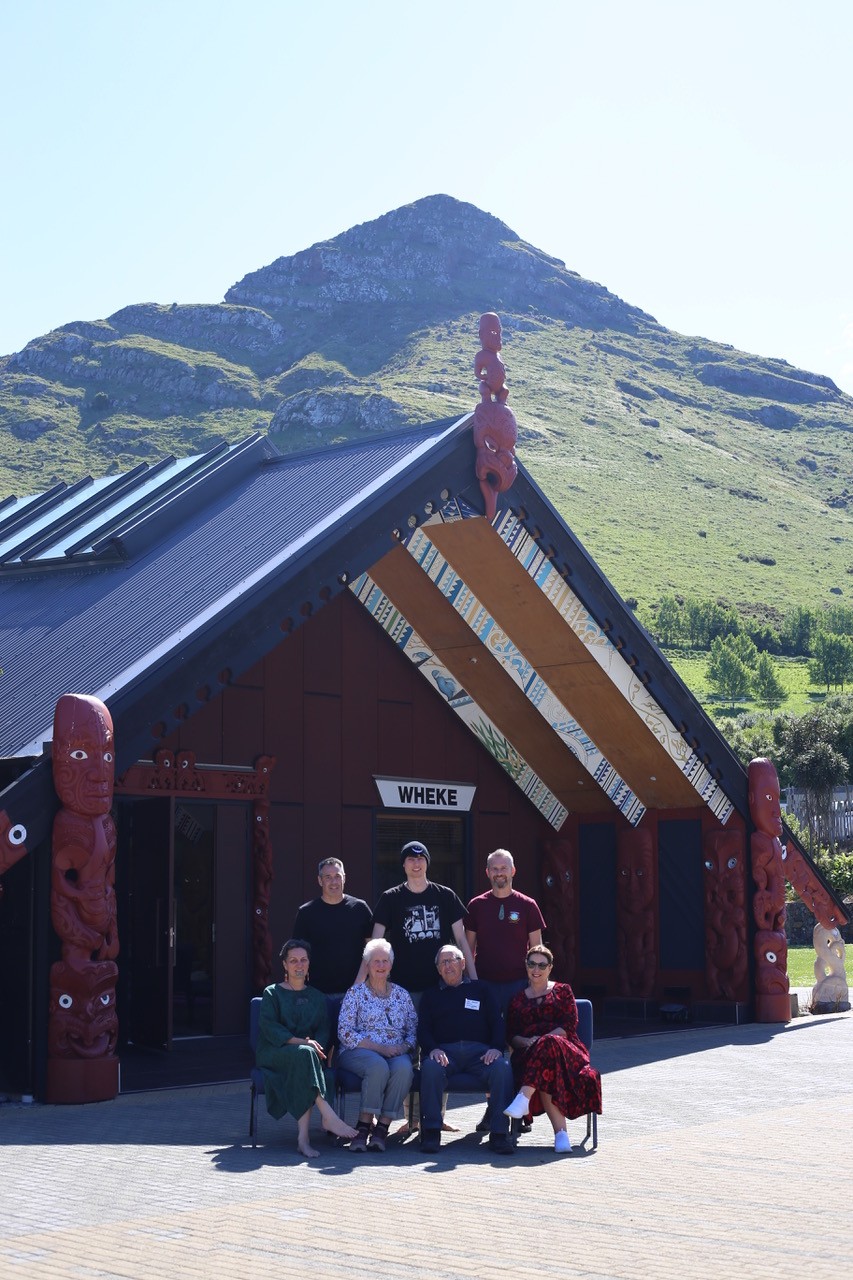 Calmans outside Wheke at Rāpaki in October, 2025. Standing: Matt Calman, Tama-te-ra Tikao Calman, Ross Calman. Seated: Ariana Tikao, Hilary Calman, John Calman, Debra Gretton.